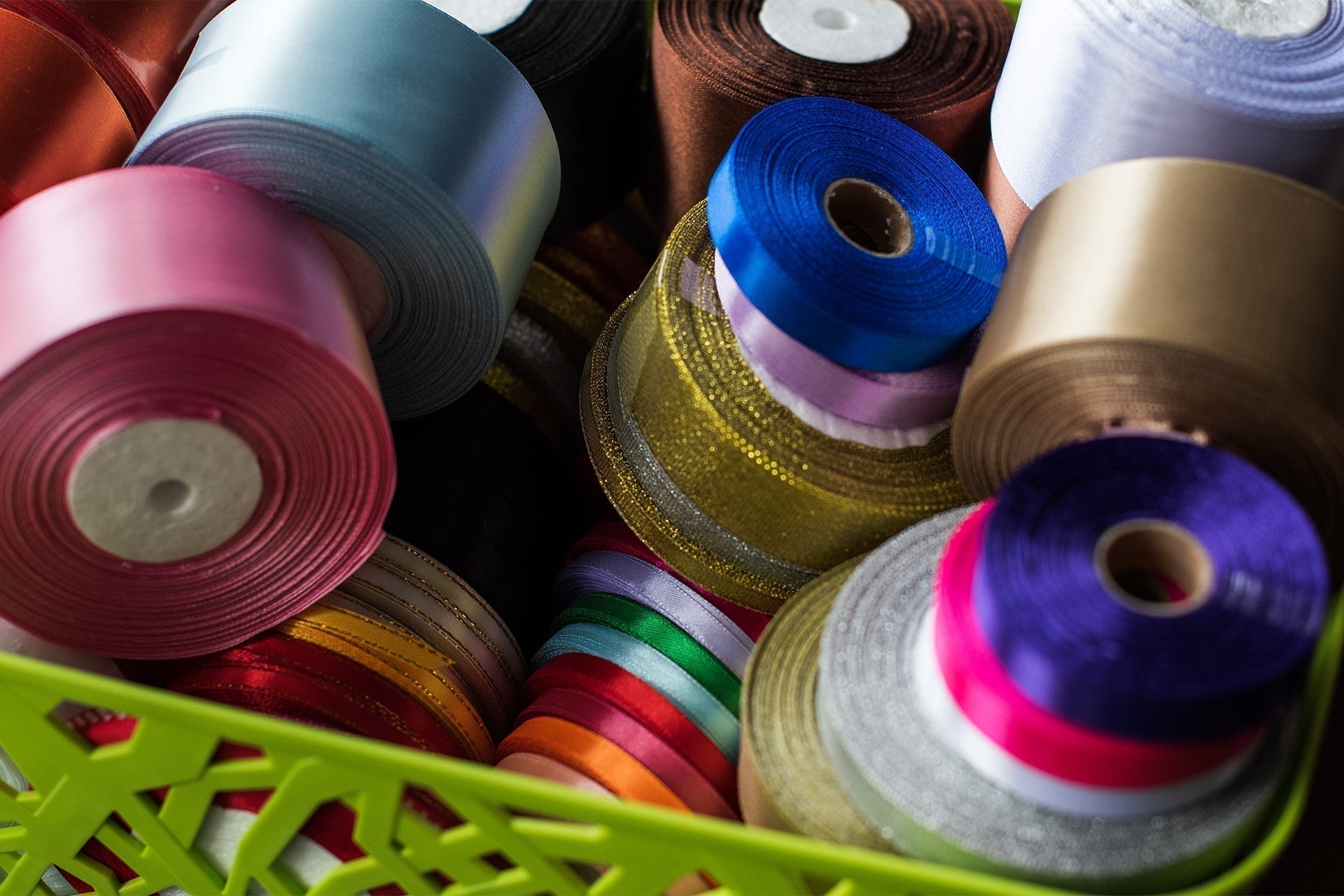
A Guide to Different Types of Ribbons: Material & Design Considerations for Every Scenario
It's easy to brush ribbons off as a mere scrap of fabric, but the history and manufacturing techniques behind these iconic materials have a lot more depth than many people give them credit for. Spanning numerous varieties, styles, fabrics and uses, these versatile strips come in many shapes and sizes.
To illustrate my point, we stock dozens of types of ribbons, for large-scale manufacturing operations, DIY crafts, gift wrapping, florists, cakes, product packaging, event décor, and so on – more applications than you can shake a stick at.
Read on to discover which types of ribbons are best suited to your needs, including practical tips on squaring up cost with performance. Let’s get this show on the road!
Skip ahead:
12 Popular Types of Ribbon At a Glance
Once upon a time, ribbons were a shibboleth of social class reserved for the petticoats and tresses of aristocrats, men and women alike. I’m happy to say that now, owing to modern manufacturing techniques, this is no longer the case.
Indeed, ribbons are more accessible and widely available than ever, boasting a full spectrum of colours and an almost decision-fatigue-inducing array of designs, materials and finishes.
Cropping up throughout society, not just on Christmas gifts, they’re used for making decorative sashes, garlands, bows and chair ties; you’ll see them on seasonal wreaths, adorning bouquets and topping off decorations; they’re a staple in ribbon embroidery and all sorts of craft projects. Yes, they’re pretty ubiquitous in the home décor and fashion worlds.
Here are the most popular types in a neat list:
- Satin Ribbons
- Grosgrain Ribbons
- Organza Ribbons
- Petersham Ribbon
- Gingham Ribbons
- Cotton Ribbons (Flat or Herringbone Weave)
- Jute Ribbons
- Velvet Ribbons
- Lurex/Metallic Ribbon
- Brocade / Stitched
- Lace Ribbon
- Curling Ribbon
Besides these common types by material and design, ribbons may also be stitched or printed to add textural/visual detail, wired to hold their shape, woven in different patterns (think: a herringbone weave vs gingham), and cut to different sizes.
As such, you can get really granular with your specifications to ensure your ribbons are exactly what you want for an event or occasion, project, or products.
Breaking Down the Options By Materials, Design, Finish & Size
So, you have an inkling of the possibilities. Now, let’s dig deeper into the different types of ribbon designs and materials, what makes each tick.
While some might have a similar surface appearance, you’ll find that certain ribbons are made for specific use cases. Case in point, the wired vs non-wired and flat vs woven distinctions – but more on that later.
Materials

Satin Ribbons: Best for Striking Gift Wrapping & Packaging
Typically made from silk or polyester, satin ribbons are immediately identifiable owing to their smooth, glossy finish. What sets it apart from other materials is the sweet spot it manages to occupy between budget-friendliness and luxurious appearance.
Originating in ancient China, but now more closely associated with formalwear, you’ll likely see satin ribbons topping brand packages, luxury packaging and professionally wrapped gifts. Why, you ask? Besides the affordable yet elegant character it brings, these types of ribbon are pretty sturdy; the satin weave tightly knits together long filament fibres to create a structure more robust than many plain weave fabrics, doubly so if two-sided for extra strength.
Features:
- Shiny, smooth finish
- Premium look
- Relatively durable
- Wrinkle-resistant
- Easily snagged, so not suited to high-wear scenarios

Grosgrain: My First Choice for Flower Arrangements
Grosgrain ribbon is primarily known for the ribbed woven texture responsible for its inherent durability. For this reason, it’s often used for applications that require a pinch more strength than your average flat ribbon can handle; I’m thinking hair accessories, lanyards, apparel trims, retail gift packaging (like hampers), and, traditionally, milliners' hatbands.
Today, it’s one of our most popular products ordered by florists. Since its thickness allows the ribbon to keep its shape, grosgrain is particularly pliable for hand-tied bouquets, flower boxes, bridal and corporate arrangements and tablescapes. That said, I’d recommend it for any scenario where a firm, more rigid ribbon is in order.
Features:
- Strong ribbed texture
- Brings a defined, contemporary look
- Made from high-quality cotton, polyester or nylon
- More robust than flat ribbons
- Maintains its shape, even after frequent handling

Organza: A Top Contender for Event Décor, From Weddings to Parties
A lightweight, sheer and wonderfully crisp plain-weave fabric, organza is frequently the order of the day for life events and occasions requiring a touch of grace or romance. This fine, delicate ribbon is traditionally made from silk, though modern manufacturing favours synthetic materials for surplus strength.
With a subtle sheen, it’s intrinsically suited to bridalwear and event décor – ribbon roses, pew bows, chair sashes, table runners, hair accessories, and party garlands spring to mind in an instant.
Features:
- Breathable, transparent
- Stiff yet lightweight
- Light, airy appearance
- Cost-effective
- Made from either natural or synthetic materials

Petersham: Ideal for Tailors & Crafters Alike
A close relative to the grosgrain ribbon, Petersham likewise has a longstanding history that harks back to Victorian tailors and milliners. Featuring what is called a ‘picot edge’, you get lovely detailing in the scalloped sides, composed of continuous tiny decorative loops.
Because it was originally intended for tailors – its inventor, Viscount Petersham, designed it to take on the curve of a fabric once steamed – the eponymous ribbon packs a lot of strength. Hence, it’s usually found in fashion and home décor contexts where durability is key.
Features:
- Thick, stiff footprint
- Flexible weave pattern with great stability and strength
- Decorative scalloped edge
- Brings a classic heritage appeal
- Can be shaped with an iron

Gingham: An Unrivalled Option for Countryside Whimsy
Gingham evokes immediate connotations of springtime, picnics, cottage interiors, and maybe even grandma’s house. Woven from dyed yarns arranged in a blocky chequered design, it combines decent strength with an iconic colour pattern.
Of course, this is an excellent ribbon for any DIY or craft project seeking to inject countryside whimsy, but I’d immediately point you towards easter bonnet hatbands, quirky garment trims, springtime door wreaths, and DIY headbands. You need only head over to Pinterest to see a wealth of ideas.
Features:
- Plain-woven for good strength
- Duo tone check pattern
- Possesses a whimsical, pastoral charm
- Traditionally made from cotton, but replicated in synthetic materials

Cotton: My Top Recommendation for Eco-Conscious Brands & Crafters
Cotton ribbon is just as much a timeless aesthetic choice as an eco-conscious one. Comprised of natural, plant-based material, it offers a simple appearance tempered by a warming texture thanks to the weave pattern.
Usually, finished with a natural, matte finish, this type of ribbon material is suited to gift wrapping, ribbon embroidery and any sort of handicraft project or commercial product that would benefit from a more sustainable alternative to polyester.
Features:
- Natural, sustainable material
- Warm, matte finish
- Its weave brings wonderful strength
- Can be washed, unlike its synthetic counterparts

Jute: The Eco-Conscious Consumer’s Go-To
Another planet-friendly type of ribbon, jute doesn’t compromise on durability. The material, composed of coarse, strong threads, is woven from completely biodegradable, plant-sourced fibres. So, here you get the best of both worlds: a striking natural aesthetic with great longevity and a clean conscience.
We supply the stuff to both ecologically minded consumers and businesses, with these charming ribbons ending up on rustic garlands, Christmas decorations, embellished mason jars, plant pots, clothing and a whole manner of accessories.
Features:
- Rustic, back-to-basics appeal
- Sustainably sourced and biodegradable
- Strong and long-lasting
- The coarse texture means it’s not ideal for all garments

Velvet: A Natural Option for Seasonal or Luxury Use Cases
Few other ribbons can match the plush texture and depth of colour that velvet ribbon has to offer. Indeed, it’s a little pricier than the synthetic alternatives; nonetheless, I wouldn’t hesitate to say that it’s worth it, given the striking effect.
It’s something we often supply for premium bouquets, festive florals and statement pieces, be they decorations or fashion accessories. Needless to say, they’re less common than other types of ribbons; however, when they do make an appearance, they certainly make a splash.
Features:
- Plush, soft texture
- Deeply pigmented, thus great for autumn and winter applications
- Decent strength
- Higher price point, but worth the touch of luxury

Lurex: A Fitting Christmas Embellishment
Lurex ribbons are made from a metallic yarn created by 1940s pioneers who laminated aluminium with plastic film. Take a glance at the stuff, and it’s easy to guess where it excels: Christmas tree ribboning, children’s accessories, handicrafts with a bit of sparkle, any application where a glitzy sheen is necessary.
Features:
- Light reflective and metallic
- Soft and flexible
- Lightweight yet durable
- Comprised of a blend of metal fibres and polyester

Brocade or Stitched Ribbon: Impress
Short and sweet, these are ribbons with designs woven or stitched into them by hand with the express purpose of looking beautiful. Adding to the homely appeal and a sense of novelty, stitched ribbons make stunning gift wrapping accompaniments, especially when matched to the recipient’s interest. Do note that many varieties have a right and a wrong side.
Features:
- Extra stitched or woven detailing
- Elaborate patterns
- Suited to hyper-visual applications
- More expensive than other types

Lace Ribbon:
Lace is ribbon is as decorative as it gets. These textural strips of fabric feature intricate designs, often open-weave, webbed, or with scalloped edges. Like your standard ribbon, they are well-matched to gift wrapping, crafting, sewing, and decorating applications; however, the difference lies in the timeless, refined beauty they bring to your projects.
Features:
- Unique, vintage aesthetic
- Versatile uses across embroidery and fashion
- A more formal look
- Soft, flexible and easy to shape

Curling Ribbon: A Classic for Birthday Present Wrapping
You’re likely already familiar with curling ribbon; it’s the ultra-thin synthetic ribbon that adorns birthday and Christmas presents. Its hallmark is that, armed with a pair of scissors, you can pull the material over the blades to create a fun, curly effect.
Features:
- Affordable
- Easy to manipulate and use
- Comes in a variety of finishes from matte to metallic
- Provides a fun, glitzy look
Design & Finish
Besides the materials, there are yet more types of ribbons to wade through, so it’s understandable that your head might be spinning at this point.
Here’s a simple way to cut through the noise: on top of the fabrics they’re composed of, you have ribbons that are wired, non-wired, woven and unwoven; some bearing stitches, printed patterns, or treated to create a particular finish.

Wired vs Non-Wired
Fortunately, the difference at hand is simple. Ribbons can be manufactured with a fine wire subtly integrated into the edges; this is to ensure that, when folded, they retain their shape. Wired ribbons are, thus, usually the preserve of bows or shop displays.
Regular ribbons without the wiring are flexible, and thereby better suited for softer applications, such as embroidery, scrapbooking, hair accessories and garlands.

Printed, Plain or Woven
Then we have the surface texture, which runs the gamut from printed (ideal for branding and events styling), plain (a versatile and cost-effective option for numerous use cases), and woven to bring texture and resilience into the mix.
For further visual interest, many consumers opt for unique and stimulating patterns, like a variegated ombré or a seasonal print. A timeless classic is moire, a treatment that gifts the ribbon a wavy, ‘watered’ appearance through rolling at high temperatures and pressures.

Width
Lastly, I can’t talk about different types of ribbons without mentioning size, since they’re so variable. Standard ribbon widths fluctuate from very narrow, around 3mm for delicate crafts, to very wide 100mm+ for bolder decorations. On the smaller end, there is also cord ribbon, a very fine variety popular for handicraft finishing touches, jewellery and small gifts.
Conclusion: A Whole World of Ribbons Awaits
Let’s tie these ribbons into a neat bow.
From their humble beginnings as hair accessories in ancient civilisations to their present-day abundance, there are so many types of ribbons at your fingertips. Grosgrain for ribbed strength, organza for an ethereal, feminine look, satin and velvet for an indulgent textural experience, whichever way you sway, there’s a ribbon expressly designed for your needs. This leaves one final question: which one are you going to pick?
I get it, choosing is easier said than done, especially when the options are practically endless. If your mind is wracked by indecision, I can help with that. Having worked with these elegant materials for almost half a century, Colour Ribbons has got you covered. Get in touch, and our friendly team will be much obliged to assist.
Frequently Asked Questions
What Are the Most Common Types of Ribbons?
The most common types of ribbons include satin, grosgrain, organza, cotton, and velvet. Satin is known for its smooth, glossy finish, while grosgrain is more durable with a ribbed texture. Organza offers a lightweight, sheer look, cotton provides a natural, matte option, and velvet delivers a soft, premium feel often used for luxury or seasonal applications.
Which Ribbon Material Is Best For Packaging?
Satin and grosgrain ribbons are typically the best choices for packaging. Satin works well for premium or gift packaging due to its smooth, high-end appearance, while grosgrain is more durable and holds its shape better, making it ideal for retail packaging and repeated handling.
Which Ribbon Holds Its Shape Best?
Wired ribbons and grosgrain ribbons hold their shape best. Wired ribbons are designed specifically for structured bows and displays, while grosgrain’s thicker, ribbed construction gives it natural rigidity, making it a reliable choice for crafts and packaging where shape matters.
What Type of Ribbon Is Best for Crafts?
Grosgrain and cotton ribbons are among the best options for handicrafts. Grosgrain is strong, easy to work with, and holds its shape well, making it ideal for hair accessories and DIY projects. Cotton ribbon is a good alternative for more natural or eco-conscious crafts, offering flexibility and a softer finish, perfect for ribbon embroidery.
Are There Eco-Friendly Ribbon Options Available?
Yes, eco-friendly ribbon options are available, particularly those made from natural fibres like cotton and jute, or recycled materials. Choosing biodegradable or sustainably sourced ribbons can help reduce environmental impact, which is ideal for businesses or individuals looking to align practices with their values.
How Do Synthetic Ribbons Perform?
Ribbons made from synthetic materials like polypropylene or acetate tend to be shiny finish-wise and have a cut edge. They are very robust, making for great additions to DIY home décor projects and gift wrapping, but be warned, they can fray over time, so aren’t as suited to heavy wear. While synthetic ribbons can’t be washed like their woven fabric counterparts, they remain a cost-effective option, especially when ordering in bulk.